Practice.
Not paperwork.
Orella runs your clinical workflow end to end — so you can spend the visit thinking, not clicking.
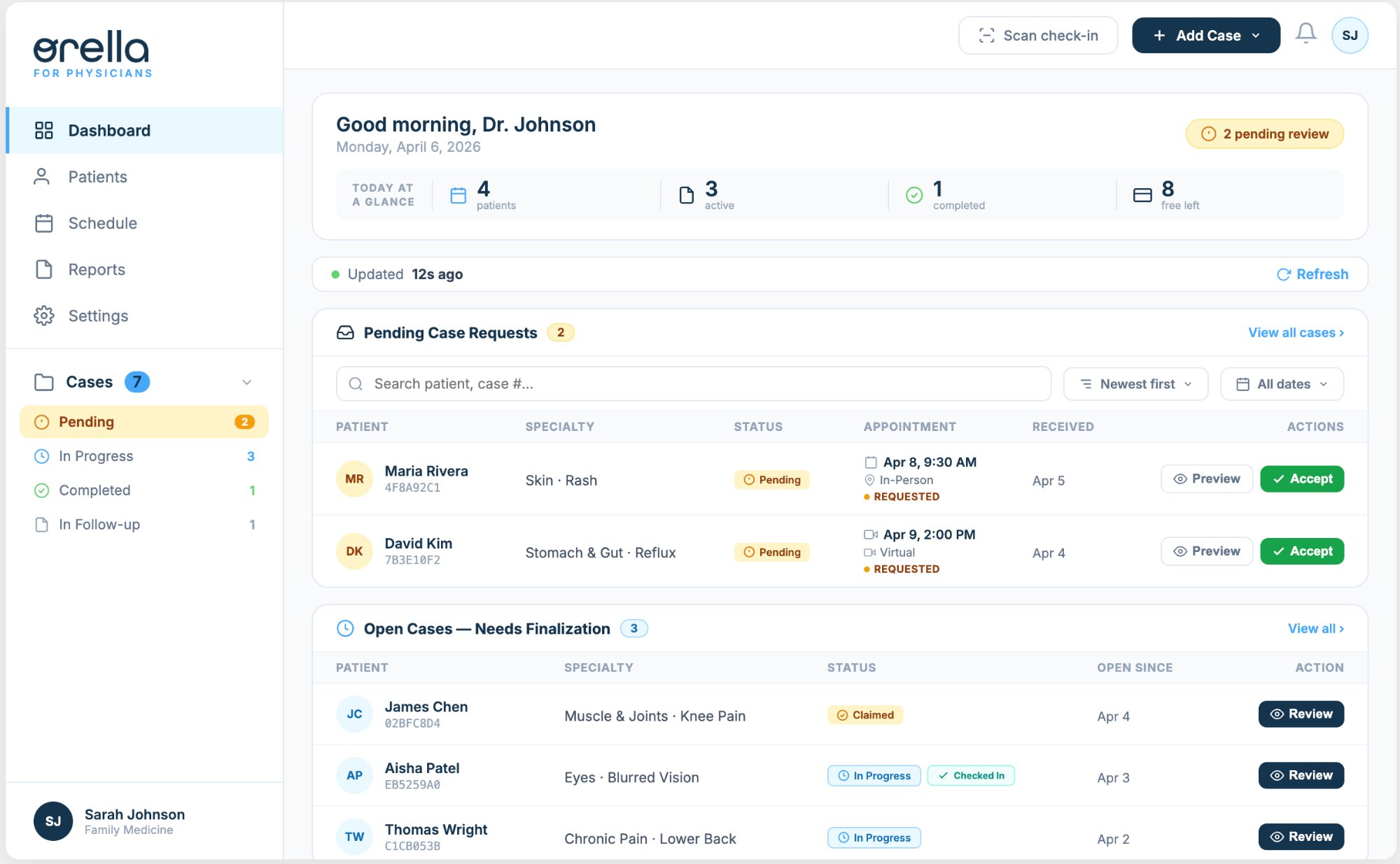
One panel. The whole encounter.
No tab-switching, no second-screen software, no fighting the EHR.
The patient describes. The exam is captured. The consult note drafts itself in your voice.
Observation windows expire, follow-ups schedule, referrals route — without you tracking any of it.
They arrive ready — describe done, photos uploaded, history filled. The visit starts where it should.
Patients describe in their own language. You read it in yours. No interpreter, no friction.
The 4D framework
Four phases. As few decisions as the medicine actually requires.
Every encounter moves through the same four phases. Each one is shaped so the parts that need your judgment stay yours, and the parts that don't, automate.
01 · Describe
The patient narrates their symptoms before they arrive. Structured, complete, in their language and yours.
02 · Detect
Photos, prior records, vitals, exam findings — gathered into one view. You see the encounter, not a folder.
03 · Diagnose
You make the call. Orella drafts the note, codes, and clinical reasoning — your edit, not your blank page.
04 · Deliver
The AVS fires. The next appointment books. The referral sends. The follow-up sets its own timer.
The encounter loop
Every visit ends with an automated disposition.
Every visit arrives prepared. Finalization sets exactly one path forward — closed, observed, followed up, or referred. Orella handles scheduling, surveillance, context-loading, and case routing on your behalf.
What you stop doing
Less busy work, more care work.
Orella isn't a tool you add on top of your clinic. It replaces the things you'd rather not be doing.
Re-typing the history at the start of every note
History arrives already written, in the patient’s own words
DescribeAsking staff to call observation patients back
Observation patients are tracked and recalled for you
DeliverWriting the AVS after the patient has already left
The after-visit summary is ready before they leave
DeliverTranslating symptoms through a phone interpreter
Patients describe symptoms in their own language
DescribeToggling between scheduler, EHR, fax, scanner, portal
Scheduling, records, and orders live in one place
One placeBuilding the patient summary from scratch
The summary builds itself as the visit happens
DetectFinishing charts at 9pm
The note is done when the visit is
DeliverSee your practice in Orella.
Open the Doc Panel, walk through a real encounter, and feel how few clicks it actually takes.